
Every independent pharmacy owner knows that time is money. But some of the most expensive inefficiencies in a pharmacy aren’t always obvious. They’re hidden in everyday activities, especially in the pharmacy will-call process.
At a glance · modeled 250-script-a-day pharmacy
~70%
less time retrieving prescriptions
~106 hrs
of staff capacity recovered per month
$2,338
in potential monthly labor value
A technician searching through prescription bins. A pharmacist stepping away from another task to help locate a misplaced prescription. Unclaimed medications sitting in will-call longer than necessary.
Individually, these moments may seem insignificant. But when they happen repeatedly throughout the day, they add up.
So what could a more efficient will-call process actually mean for your pharmacy? Let’s look at the numbers.
The Potential Financial Impact of Pharmacy Will-Call Efficiency
Consider an independent pharmacy filling approximately 250 prescriptions per day. Using an illustrative operational model, we can estimate the potential monthly labor value of improving three common areas of the will-call process.
For perspective, the 2025 NCPA Digest reports an average of about 67,600 prescriptions per independent community pharmacy in 2024, roughly 217 per day across a six-day week. Our 250-prescription scenario represents a busy but relevant independent pharmacy.
| Area of improvement | Est. monthly labor value |
|---|---|
| Reducing time spent searching for misplaced prescriptions | $1,378 |
| Faster prescription retrieval | $880 |
| Faster return-to-stock retrieval | $80 |
| Total illustrative monthly labor value | $2,338 |
These figures are estimates based on a modeled pharmacy operating 26 days per month. They represent potential labor capacity recovered, not guaranteed reductions in payroll expenses. Actual results vary by pharmacy.
Let’s break down where these opportunities come from.
1. Misplaced Prescriptions: The Hidden Cost of Searching
Traditional prescription bins have served pharmacies for decades. They’re familiar, straightforward, and relatively inexpensive. But they also rely heavily on manual organization.
A prescription gets placed in the wrong bin. Multiple prescriptions for the same patient end up in different locations. A technician spends several minutes searching while the patient waits at the counter.
Sometimes another technician joins the search. Other times, the pharmacist gets involved. And while everyone is looking for one prescription, other work is waiting.
How quickly does that time add up?
Our illustrative ROI model considers a busy pharmacy experiencing approximately 12 difficult prescription searches daily, averaging 9.6 minutes each. The model estimates that improved organization, barcode tracking, and light-guided retrieval could reduce misplaced prescriptions by 75%.
Using the model’s blended labor assumptions, that represents approximately:
Misplaced prescriptions
$1,378
in potential monthly labor value
Think about what that means operationally. Less time spent searching for misplaced prescriptions means more time available for processing prescriptions, helping patients, and keeping the pharmacy moving.
How HangRx helps
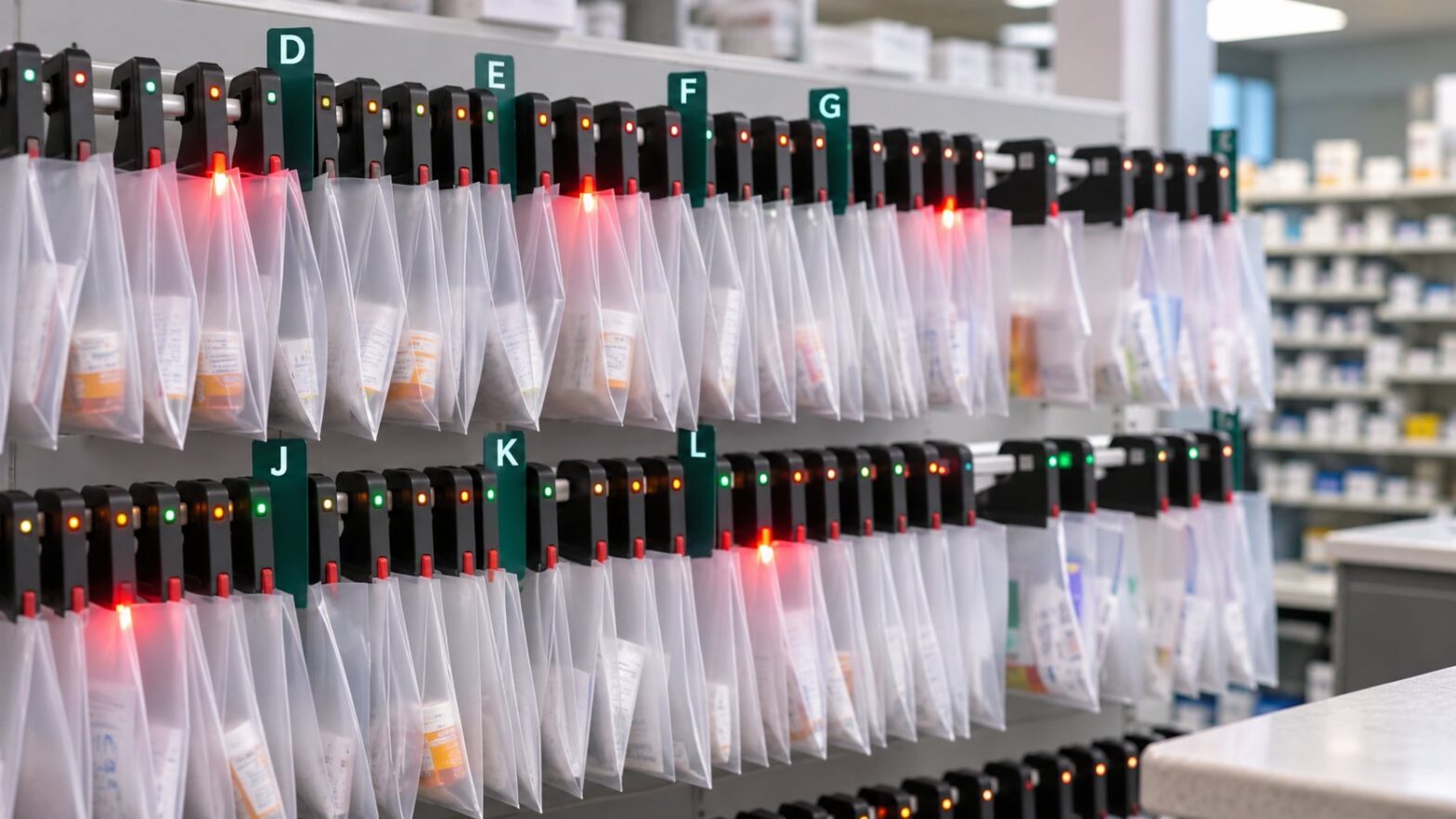
HangRx replaces traditional bins with an organized hanging bag system featuring light-guided retrieval. Each prescription is assigned to a tracked bag, making it easier for staff to locate the correct prescription. Instead of searching through bins, employees follow the illuminated handle to the appropriate bag.
The objective is simple: less time searching and fewer interruptions to the pharmacy’s workflow.
2. Pharmacy Will-Call Retrieval: Why Every Second Matters
Not every pharmacy will-call delay involves a misplaced prescription. Even when everything is organized correctly, staff still spend time locating the appropriate bin, searching through its contents, and identifying the right prescription.
Now multiply that time by hundreds of pickups. A few seconds saved on each transaction can create meaningful operational value over the course of a month.
An example of the potential impact
Our model compares two illustrative retrieval times:
| Retrieval process | Estimated time |
|---|---|
| Traditional will-call retrieval | 49.8 seconds |
| Light-guided retrieval | 15 seconds |
That’s approximately 70% less time spent retrieving prescriptions in the modeled comparison. For a pharmacy retrieving 250 prescriptions per day, the difference represents approximately 63 hours of staff time per month.
At the model’s technician labor rate of $14 per hour, that’s approximately:
Faster retrieval
$880
in potential monthly labor value
The benefit extends beyond labor
Faster retrieval also creates an opportunity to improve the patient experience. When technicians spend less time searching, they can spend more time helping patients.
When pharmacists experience fewer interruptions, they can stay focused on the responsibilities that require their expertise. And when patients receive their prescriptions more efficiently, pickup becomes a smoother part of their day.
For independent pharmacies competing on personal service, those interactions matter.
3. Return-to-Stock: An Often-Overlooked Pharmacy Will-Call Opportunity
Return-to-stock is an essential part of pharmacy inventory management. When prescriptions go unclaimed, pharmacies need to identify them, complete the appropriate return procedures, and make eligible medication available for dispensing again.
In a traditional bin-based pharmacy will-call system, that often means manually locating prescriptions that have reached their return-to-stock date. It’s necessary work, but it can become time-consuming. And when the pharmacy is busy, return-to-stock tasks may be delayed.
What could a more efficient will-call process save?
Our ROI model considers a pharmacy retrieving approximately 17 prescriptions per day for return-to-stock. Using traditional retrieval times, locating those prescriptions could take approximately 14 minutes daily. With an organized, light-guided retrieval process, the model estimates that the same task could be completed in approximately one minute.
That’s about 13 minutes of staff time recovered each day. Over 26 operating days, that represents approximately 5.7 hours of staff time, or:
Return-to-stock
$80
in potential monthly labor value
It may seem like a small amount compared with the other categories, but return-to-stock efficiency also creates an opportunity beyond labor.
Better inventory availability
Medication sitting in will-call is inventory that may not be available for another patient. An organized return-to-stock process can help pharmacies identify unclaimed prescriptions sooner and make eligible medication available for dispensing again.
For example, our model considers a pharmacy returning prescriptions every ten days. Under those conditions, some prescriptions may remain in will-call for up to 19 days before being returned. Moving to a more consistent daily return-to-stock process could potentially free up approximately nine prescriptions’ worth of inventory. At an illustrative average cost of $47 per prescription, that’s approximately:
Inventory availability
$423
in potential one-time inventory reduction
This is a separate, potentially one-time inventory benefit rather than an additional $423 in recurring monthly savings.
How HangRx supports the process
HangRx uses barcode tracking to help identify prescriptions that need to be returned to stock. Staff can locate the appropriate bags through the system rather than manually searching through bins. This supports a more organized process and helps pharmacies manage unclaimed prescriptions with greater consistency.
4. What Does $2,338 in Monthly Labor Value Really Mean?
When we combine the three labor-efficiency categories, our illustrative model identifies approximately $2,338 in potential monthly labor value.
$2,338
potential monthly labor value
~106 hrs
of staff capacity recovered each month
But the real opportunity isn’t simply the dollar amount. It’s the time.
In this scenario, improvements to misplaced-prescription searches, routine retrieval, and return-to-stock could recover approximately 106 hours of staff capacity per month. That’s time that could be redirected toward other important pharmacy responsibilities:
- More prescriptions processed
- Fewer interruptions
- More attention available for patients
- Potentially greater capacity to handle daily workload without adding staff
For a busy independent pharmacy, those will-call improvements can make a meaningful difference.
5. How to Evaluate Your Own Pharmacy’s Will-Call Process
Every pharmacy operates differently. A pharmacy filling 150 prescriptions per day may have different challenges than one filling 500. Staffing levels, prescription pickup patterns, pharmacy layout, and existing workflows all influence the potential value of automation.
To understand where your pharmacy could benefit, start by asking:
- How often does our team search for misplaced prescriptions?
- How long does it typically take to retrieve a filled prescription?
- How frequently do retrieval problems interrupt pharmacists or other staff?
- How much time do we spend managing return-to-stock?
- Are unclaimed prescriptions consistently returned to available inventory on schedule?
These questions can reveal opportunities that aren’t always obvious in day-to-day operations, and they provide a useful starting point for evaluating whether an automated pharmacy will-call system makes financial and operational sense.
6. Beyond the Numbers: More Time for Patients
Independent pharmacies have something valuable that large retailers and online services often struggle to replicate: personal relationships.
Patients return because they trust the people behind the counter. They appreciate being recognized, having questions answered, and knowing someone is looking out for them. But those relationships require time.
Every minute spent searching through will-call bins is a minute that could potentially be spent assisting a patient, completing another prescription, or supporting the pharmacy’s daily operations.
Technology shouldn’t replace the personal service that makes independent pharmacies special. It should help protect the time needed to deliver it.
That’s the philosophy behind HangRx. By organizing prescriptions, simplifying retrieval, and supporting return-to-stock workflows, HangRx helps pharmacy teams spend less time searching and more time serving patients. See how one independent pharmacy uses it in Smith Rexall Drug’s HangRx story.
The Bottom Line
Improving pharmacy profitability isn’t always about filling more prescriptions or adding new services. Sometimes it’s about making the work your team already performs more efficient.
Our illustrative model shows how a pharmacy filling 250 prescriptions per day could identify approximately $2,338 in potential monthly labor value, plus an additional opportunity to improve inventory availability through more timely return-to-stock. Your pharmacy’s actual opportunity may be higher or lower.
But the underlying principle remains the same:
Less time searching. More time serving patients.
And that’s an improvement worth exploring.
Ready to See What HangRx Could Do for Your Pharmacy?
Every pharmacy’s workflow is different. Let’s talk about your prescription volume, current will-call process, and where HangRx could help your team work more efficiently.
About the ROI Estimates
The examples in this article are based on Suncrest Solutions’ HangRx Automated Will-Call Measurable ROI model.
| Model assumption | Value |
|---|---|
| Daily prescription volume | 250 |
| Operating days per month | 26 |
| Difficult prescription searches per day | 12 |
| Average difficult-search time | 9.6 minutes |
| Modeled reduction in misplaced prescriptions | 75% |
| Traditional routine retrieval time | 49.8 seconds |
| Modeled light-guided retrieval time | 15 seconds |
| Technician hourly labor rate | $14 |
| Pharmacist hourly labor rate | $60 |
| Daily return-to-stock prescriptions | 17 |
| Average prescription inventory cost | $47 |
The model uses an equal pharmacist/technician labor mix for difficult searches and technician labor for routine retrieval and return-to-stock. Retrieval times and percentage improvements are model inputs, not independently verified performance results for every current HangRx installation. Financial values are rounded estimates.
Sources and research context
- Source: Suncrest Solutions, HangRx Automated Will-Call Measurable ROI. Primary source for the modeled calculations.
- The Thomsen Group, 2005 pharmacy workflow study. Historical research referenced in the original ROI model.
- National Community Pharmacists Association, 2025 NCPA Digest. Industry context for independent community pharmacy prescription volume.
The model is intended to illustrate potential operational improvements. Actual labor savings, inventory benefits, and financial returns depend on each pharmacy’s circumstances.
